

Last week, I watched Béziers begin the process of turning an almost completely new group of players into a team.
Tonight, they faced a different challenge.
Leicester Tigers came to Béziers.
On the surface, the obvious leadership lesson seemed to be about international experience.
Béziers already have players from different countries and cultures, as do most professional rugby teams. But playing an international opponent brings another dimension. You’re no longer simply bringing different people into your environment.
You’re encountering someone else’s.
A different system. Different habits. Different expectations. A different way of playing the game.
And that raises a question I’ve encountered many times outside rugby too:
How much of what we call “the right way” is really just “our way”?
When another world arrives
One of the great benefits of working internationally is discovering that things you once considered obvious aren’t necessarily obvious at all.
Different cultures communicate differently.
They approach hierarchy differently.
They build relationships differently.
They make decisions differently.
They disagree differently.
Even concepts like urgency, punctuality, commitment and trust can be expressed differently.
I’ve spent much of my career working internationally, and one of the things it has taught me is that encountering another way of doing something forces you to examine your own.
Not necessarily abandon it.
Not necessarily copy theirs.
But examine it.
Because sometimes we don’t even recognise our assumptions as assumptions until we meet someone who doesn’t share them.
Tonight, Béziers encountered something different.
And for the first half, it was difficult.
At halftime, Leicester led 28–5.
But the score wasn’t what interested me most.
It was what happened next.
Adapt
Béziers came out for the second half looking different.
They were stronger.
More organised.
And, perhaps most importantly, they looked better together.
They had just spent 40 minutes experiencing Leicester rather than preparing for Leicester.
There is a difference.
Preparation is based on what we think we’re going to encounter.
Experience gives us information.
And then we have a choice about what we do with it.
Béziers adapted.
The score began to change, but the adaptation was visible before the scoreboard reflected it.
And that’s often true in organisations too.
Adaptation becomes visible in the results, but it begins long before the numbers change.
An 11-year-old spotted something I hadn’t

Sitting beside me was my 11-year-old son, Declan, who plays rugby himself.
He noticed something.
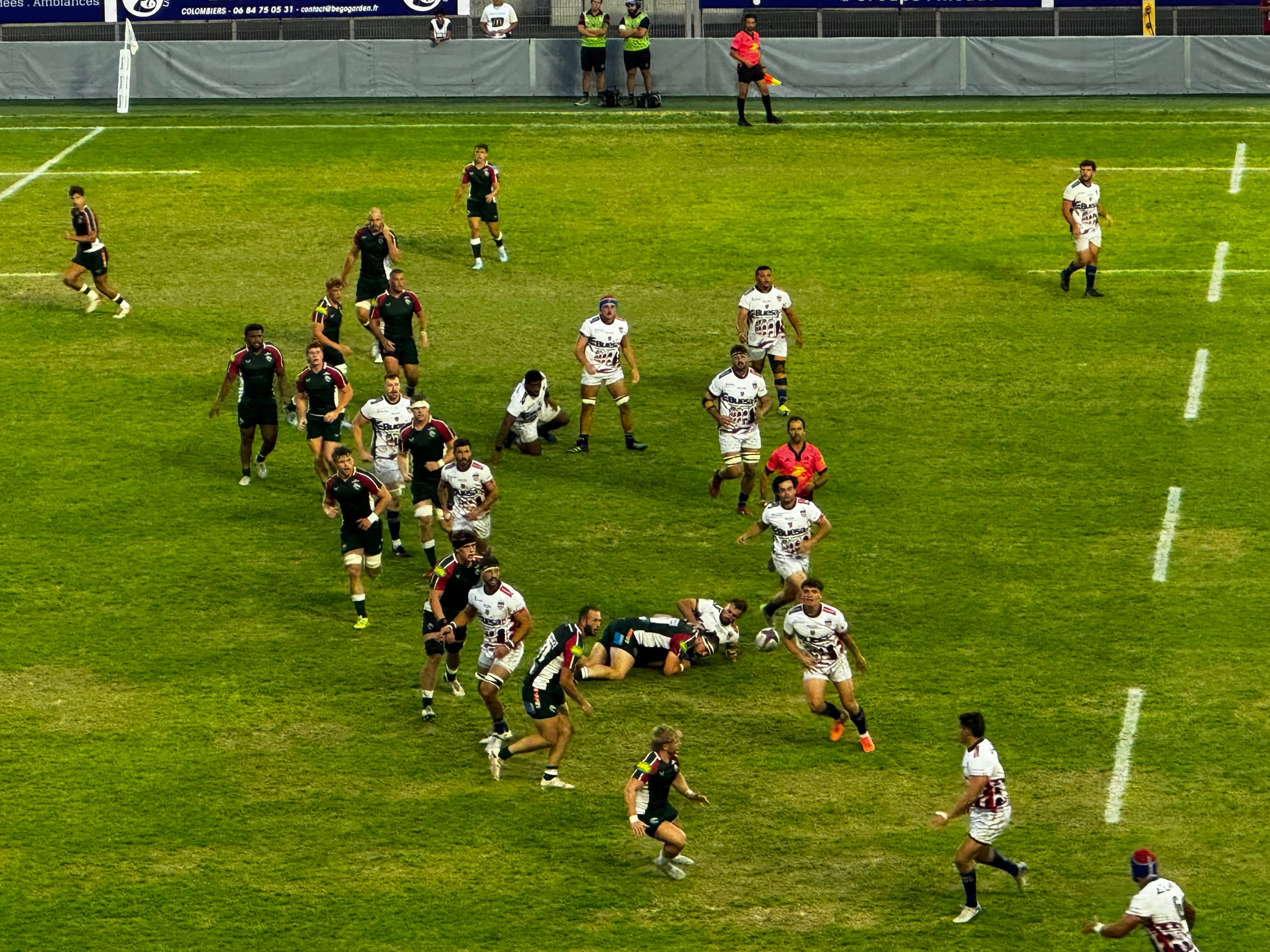
“Béziers are never in line. Leicester are.”
He explained what he’d been taught.
When he was younger, his coaches talked about escalier — literally, a staircase — as a way of teaching the players how to position themselves.
Now they talk about profondeur: maintaining depth in the attacking line.
He kept watching Leicester.
Again and again, when play moved and players had to reset, they seemed to instinctively return to that shape.
Béziers didn’t seem to have that same collective discipline yet.
And suddenly I wasn’t watching the ball anymore.
I was watching the players who didn’t have it.
There was a leadership lesson happening away from the action.
Every professional player on that pitch knows how to play rugby.
The difference wasn’t simply knowledge.
It was what had become instinctive.
Leicester appeared to have a shared structure they could repeatedly return to without needing someone to tell everyone where to stand.
Béziers, with so many new players still learning how to function together, don’t appear to have developed that same collective instinct yet.
Perhaps that’s one of the differences between knowing a system and becoming a system.
Discipline makes adaptation possible
We sometimes talk about discipline and adaptability as though they’re opposites.
Structure sounds rigid.
Adaptability sounds flexible.
But watching Leicester tonight made me wonder whether we’ve got that wrong.
Perhaps strong foundations are precisely what allow a team to adapt quickly.
If everyone understands the principles, knows their role and trusts the people around them, they don’t need to abandon the system every time circumstances change.
They can adapt within it.
That’s true in organisations too.
A strong culture shouldn’t mean, “This is how we’ve always done it.”
It should give people enough shared understanding that when something unexpected happens, they don’t have to wait for the leader to tell them what to do.
They know where to go.
They know what matters.
They know what the team is trying to achieve.
Perhaps culture is most visible in what people do when nobody has time to tell them what to do.
And then Leicester changed
But the most interesting part of the evening was still to come.
Béziers’ second-half response began working.
They became more organised. They started playing better together. They scored.
And Leicester responded.
They raised their game again.
That matters.
Because the world doesn’t politely stand still while we adapt to it.
Competitors respond.
Customers change.
Markets evolve.
Technology moves.
People learn.
The solution that worked yesterday changes the environment in which tomorrow’s problem will appear.
You adapt.
Someone else responds.
And suddenly the thing you adapted to has changed again.
The moment you adapt isn’t the moment you’ve arrived. It’s the moment the next adaptation begins.
Adapt and change
Leicester eventually won 35–19.

But this isn’t really a story about the final score.
It’s about what happened between the first whistle and the last.
Two teams encountered one another.
One initially appeared considerably more settled and disciplined.
The other adjusted.
The first responded.
Both changed because of what the other was doing.
That’s international experience at its best.
Not simply collecting different nationalities around a table.
Not assuming another country’s way is better.
And certainly not abandoning everything that makes your own organisation distinctive.
It’s allowing exposure to another way of doing things to challenge the assumption that yours is the only one.
Observe.
Learn.
Adapt.
And then keep watching.
Because the other side is learning too.
The best teams — and perhaps the best leaders — aren’t those who find the perfect way of doing something and protect it forever.
They’re the ones with foundations strong enough to know who they are, and the curiosity and humility to change when the game demands it.
Adapt and change.
Because the moment you adapt, the game changes again.