

Three Years Later
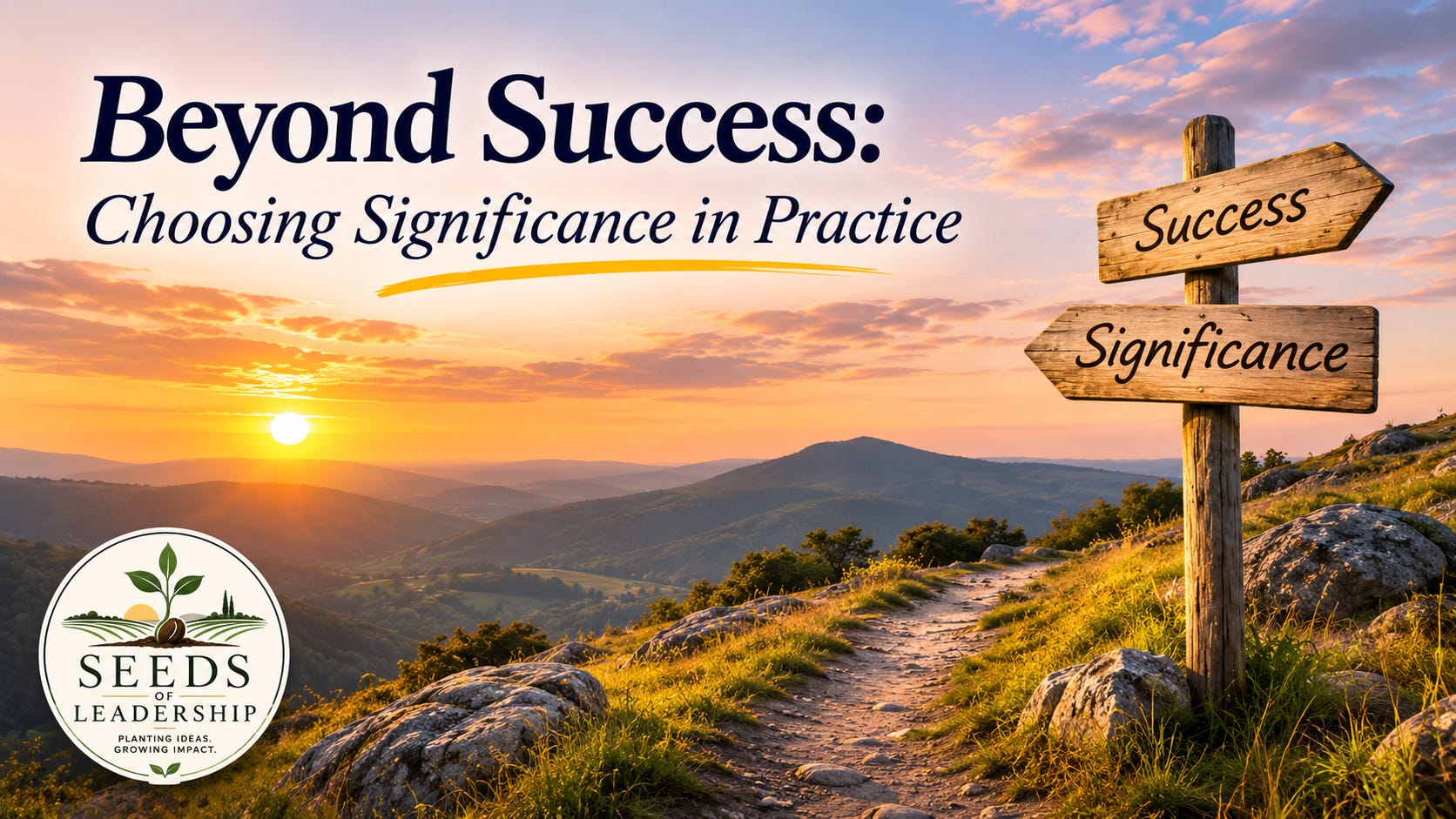
In October 2023, I wrote an article titled Why I Favour Significance Over Success. It was built around a simple statement that has influenced much of my thinking about leadership, relationships and the way we approach life. And it is based on one simple, but important (to me) sentence:
“It’s not about who I am, but about who I am to you.”
When I wrote it, I was leading a software business that I’d been part of for more than fifteen years. Like most business leaders, I had ambitions for the organisation, responsibilities to its employees and customers, and objectives against which our performance could be measured. Growth, profitability, innovation and commercial success were all important, and they remain so. But I’d increasingly come to believe that these measures, however valuable, couldn’t tell the whole story of what made our efforts worthwhile. Success could tell us something about what we had achieved, but it didn’t necessarily tell us much about the differences we make along the way.

Now, three years later, I find myself returning to that article from a different perspective. In June 2026, after almost eighteen years with Agronomix, I stepped away from the business and began considering the next chapter of my professional life. It’s been an interesting period, not least because I’ve had the opportunity to reconnect with people whose paths crossed mine during those years. Some conversations have been about potential opportunities, others about what people are doing now, and many have simply been an enjoyable opportunity to catch up, exchange ideas and learn from one another.
What has struck me is how much satisfaction I’ve taken from those relationships. I’m proud of what we accomplished as a business, the products we developed and the growth we achieved. Yet when I reflect on those years, it’s the people I met, the relationships we developed and the opportunities we had to influence one another that stand out most clearly. Many of those relationships began because of the positions we held or the organisations we represented, but their value hasn’t necessarily ended simply because those circumstances have changed.
Looking back, my fundamental view of success and significance has not really changed. And I’ve never believed they were mutually exclusive, nor that pursuing one should require sacrificing the other. What has developed is my appreciation of how significance is expressed, often through relatively ordinary interactions, the opportunities we create for others and our willingness to learn from the people around us. It’s also made me consider something I perhaps didn’t explore sufficiently in my original article: significance isn’t simply about the difference we make to others, but also about the difference they make to us.
What Remains When the Title Is Gone?
Throughout our professional lives, we meet people because of the positions we hold, the organisations we represent and the responsibilities we carry. Some relationships are brief and transactional, while others develop through years of shared experiences, challenges, successes and, occasionally, disappointments. We work together, exchange ideas, solve problems and help one another achieve objectives. Over time, those interactions can develop into relationships that extend well beyond the original reason our paths crossed.

One of the things I’ve particularly enjoyed since leaving Agronomix has been reconnecting with people from different stages of my career. Some were customers, others were business partners or industry colleagues, and some were people I’d simply had the pleasure of getting to know along the way. Our conversations have varied considerably. We’ve talked about business developments, new opportunities, personal experiences and the directions our respective lives are taking. What I’ve appreciated most is the opportunity to continue those conversations without necessarily having the same professional responsibilities or objectives that originally brought us together.
These conversations have also reminded me that relationships are rarely one-directional. I’ve always enjoyed learning from others, understanding their perspectives and exploring how I might contribute to their professional or personal development. Sometimes that involves sharing experience or offering a different perspective; at other times, I’m the one gaining a new understanding or discovering an opportunity I hadn’t previously considered. The value lies in the willingness to engage, listen and learn from one another, rather than simply in what either person can offer.
It’s tempting to think about significance primarily in terms of the influence we’ve had on others. Perhaps we’ve helped someone develop their career, encouraged them through a difficult period or contributed to an important decision. Those experiences matter, but focusing exclusively on our own contribution risks overlooking the influence others have had on us. Many of the people I’ve worked with have challenged my thinking, broadened my understanding and helped shape the person and leader I’ve become. Their significance in my life is every bit as worthy of recognition as any influence I might have had in theirs.
I don’t believe the value of a relationship can be measured simply by how long it lasts or whether it continues after our professional circumstances change. Some interactions are brief but meaningful, while others develop over many years. Nor can we assume that a positive relationship necessarily means we’ve made a lasting difference to someone. What we can do is recognise that every interaction offers an opportunity to influence and be influenced, and that the significance of those moments may not always be immediately apparent.
Significance in the Everyday
When we think about making a significant difference, it’s easy to imagine something extraordinary: a major achievement, a life-changing decision or an act of generosity that has a lasting impact on someone. Yet I’ve increasingly come to believe that significance is often found in much smaller, seemingly ordinary interactions. The way we treat people, the encouragement we offer, our willingness to listen and the time we make available to others can all make a difference, even when we don’t immediately recognise it.

Significance isn’t reserved for those in leadership positions, or those who have achieved professional success, wealth or influence. It can develop through our relationships with family, friends, colleagues and even people we encounter only briefly. We can offer advice and guidance, encourage someone through a difficult period, help them develop their abilities or simply share in their moments of joy. We can choose to approach our relationships with the intention of making a positive difference irrespective of how significant these contributions turn out.
I feel empathy plays an important part in recognising where those opportunities might exist. It’s one thing to want to help someone, but quite another to understand what they might actually need from us. I’ve often found myself considering this simple question: Who does this person need in their life right now? Perhaps they need encouragement, someone to listen, an opportunity to develop, or simply someone to celebrate with them. Psychologist C. Daniel Batson (1991), through his research presented in The Altruism Question: Toward a Social-Psychological Answer, suggested that empathic concern can motivate us to help others out of genuine concern for their wellbeing. That resonates with my own thinking, although empathy also requires humility. We cannot assume we understand someone’s circumstances simply because we’ve noticed something about them. Sometimes we need to ask questions, at other times we need to just listen, and arguably most importantly, we need to recognise that someone else may be better placed to help.
This is a crucial distinction for me. Our objective shouldn’t be to make ourselves significant to others, but to understand them well enough that we might make a positive difference. Whether that difference ultimately becomes significant is not entirely ours to decide, or even to know. What we can choose is to be attentive, available and encouraging, approaching others with empathy, curiosity and a willingness to contribute something positive to their lives.
The Responsibility of Influence
While significance is something pursuable by all, I believe it takes on particular importance when we are in positions of leadership because the decisions, behaviour and attitudes of leaders can influence the experiences of many people. Leadership provides opportunities to encourage, develop and recognise others, but it also brings a responsibility to understand that individuals have different needs, aspirations and ways of engaging with the world.

During my years at Agronomix, I had the privilege of working with a remarkably diverse team. At one point, we had approximately eighteen employees representing fourteen different nationalities, bringing together a wide range of cultural backgrounds, professional experiences and perspectives. The company’s founder had naturally cultivated an environment in which people could be themselves and share their thoughts openly, and I became increasingly intentional about preserving and developing that environment.
One of the ways I approached this was simply by spending time with people individually, often sitting alongside them at their desks or having lunch with them. We talked about their work, their families or whatever they felt comfortable sharing. I wasn’t necessarily looking for a particular outcome from those conversations. I wanted to understand the individuals I worked with, to know what mattered to them and how they saw the world. I’ve long been interested in the idea of Temet Nosce (’Know Thyself’). Understanding our own tendencies, strengths and limitations can help us recognise that other people may experience situations very differently. While I tend to process information internally and consider myself more introverted in my thinking, I’ve learned to adopt a more outwardly expressive approach when leadership situations require it. Equally, I’ve recognised that some colleagues are comfortable expressing their opinions immediately, while others prefer time to consider the information before contributing. Neither approach is inherently better, but understanding those differences can help us create opportunities for everyone to participate in ways that work for them.
This became particularly relevant in our regular Town Hall meetings. These were opportunities to share information about the business, including financial performance, sales, customer success and wider strategic developments, but I also wanted them to provide a platform for employees to share their own work and ideas. Rather than expecting everyone to contribute spontaneously, I would invite individuals to prepare a slide about something they were working on and present it to the wider team. This gave them time to organise their thoughts and, importantly, allowed their colleagues to hear directly from the person responsible. I wasn’t interested in gathering information that I could subsequently present myself. I wanted people to have the opportunity to explain their thinking, contribute to discussions, receive recognition for their own ideas, and outline any struggles they were experiencing so others could offer ideas.
What began as meetings scheduled for an hour would sometimes continue for more than two, as colleagues started discussing challenges, offering suggestions and volunteering to help one another. Those conversations weren’t always perfectly balanced, and not everyone participated with the same confidence or enthusiasm. But they demonstrated what could happen when people were given opportunities to share their knowledge and experience. The value was in the relationships being developed and the willingness of colleagues to support each other, rather than the information exchanged.
This reminds me of Jane Dutton’s (2003) work on high-quality connections in the workplace, which explores how the relationships we develop through everyday interactions can influence our experience of work.
Learning to Be Influenced
One of the things I’ve come to appreciate about significance is that influence rarely travels in one direction. We might set out to encourage someone, offer guidance or create an opportunity for them to develop, only to discover that we’ve learned something valuable ourselves. This is particularly true in leadership, where it’s easy to become so accustomed to providing direction and making decisions that we overlook how much we can learn from the people around us.
I’ve always enjoyed working with people who bring different perspectives, experiences and expertise to a discussion. Indeed, I’ve often found that some of the most valuable contributions come from those who see a situation differently. But encouraging people to express their opinions also means being prepared to hear things that challenge our own understanding, and occasionally to acknowledge that we’ve got something wrong.
I remember one strategy meeting at Agronomix in which an employee questioned an assumption I’d made while explaining our direction. My understanding had come from an earlier conversation with that same individual, but I’d interpreted what they’d told me as applying to every situation. In reality, it was correct most of the time, but not always. When I began asking questions, the employee understandably became a little defensive. I acknowledged that the assumption was mine, apologised and continued asking questions to better understand the circumstances in which it didn’t apply. What followed wasn’t a dramatic change in strategy, but a more accurate understanding of the situation, reached through a conversation in which the employee could explain their perspective directly to the team.
What interests me most about that interaction is how it demonstrated the importance of being willing to learn from the people we might otherwise think of ourselves as developing. I had created an opportunity for someone to challenge my thinking, but that opportunity would have meant very little if I hadn’t been prepared to listen, acknowledge my misunderstanding and consider their perspective. Equally, the employee had the opportunity to share their knowledge openly and receive recognition for something I’d overlooked.
I certainly haven’t always got these things right. There have been occasions when I’ve misunderstood someone, been too quick to form an opinion or failed to recognise the value of a contribution until later. But experiences like these have reinforced my belief that significance is rarely a one-way relationship. The people we seek to influence can also shape our thinking, challenge our assumptions and contribute to our own development. Perhaps part of pursuing significance is recognising that we don’t always have to be the person offering something; sometimes we need to be willing to receive it.

The Siblings of Success and Significance
I’ve come to think of success and significance as something like siblings. They share much in common, and they can complement one another wonderfully, but they aren’t identical. Nor do they always travel together. Sometimes one flourishes while the other struggles, and sometimes they grow alongside one another.
When I first wrote about significance in 2023, I wasn’t suggesting that success was unimportant or that ambition should somehow be discouraged. I’ve spent much of my professional life pursuing business growth, developing products, creating opportunities and working towards commercial objectives. I take considerable satisfaction in those achievements. But I’ve also come to appreciate that success, however we choose to measure it, doesn’t necessarily tell us much about the difference we’ve made in other people’s lives.
A few years ago, one of my nephews was considering starting his own business. Having previously served in the Grenadier Guards, he brought with him a strong sense of discipline, standards and personal responsibility, but he wasn’t entirely sure where to begin. During one of our conversations, I encouraged him to consider where he could make a difference in people’s lives rather than about how much money he might make.
He went on to establish a path and roof cleaning business, approaching his work with the same high standards and principles that mattered to him personally. Over time, the business developed, customers recommended him to others, and commercial success is following him. He even received recognition from his local business community for the positive difference he was making. I’ve enjoyed watching his progress, and seeing him maintain his principles while building the business brings me additional satisfaction.
Of course, it would be misleading to suggest that his success was an inevitable consequence of wanting to make a difference. Building a business requires hard work, sound judgement, perseverance and a willingness to learn. Nor would I claim that our conversations have been responsible for what he subsequently achieved. He made the decisions, took the risks and did the work. But his experience illustrates something I’ve believed for a long time: pursuing significance and achieving success can be complementary ambitions. Making a positive difference can give our work purpose, and success can give us more opportunities to make that difference.
I think the same principle can apply in many areas of life, whether we’re starting a business, establishing a ministry, developing a career or considering what we want to accomplish. There is nothing inherently wrong with pursuing success, recognition or financial security. The question, perhaps, is whether those achievements are the ultimate objective or whether they serve something we consider more meaningful.
Success marks progress. It does not define the destination.
For me, that distinction is increasingly important. Success can be measured through milestones, achievements and outcomes, while significance asks us to consider what those things have meant to others. They may develop together, but neither is a reliable measure of the other. And perhaps the most rewarding experiences are those in which we can look back with satisfaction not only at what we’ve accomplished, but also at the people whose lives have been positively influenced along the way.
And Who Am I to You?
Three years after writing my original article, I find myself returning to the same simple statement:
“It’s not about who I am, but about who I am to you.”
I still believe it captures something important about how we approach our relationships, our responsibilities and the opportunities we encounter throughout life. But reflecting on it again has helped me appreciate that significance is perhaps less about the impact we hope to have and more about the way we choose to engage with the people around us.
We cannot decide how significant we will be in someone else’s life. We may never know whether a conversation, an act of encouragement or a moment of understanding made any lasting difference. Equally, we may not always recognise the influence others have had on us until much later. What we can do is approach those interactions with intention, empathy and a willingness to learn, recognising that even seemingly ordinary encounters can hold opportunities to make a positive difference.
My ambitions haven’t disappeared, and I certainly haven’t stopped wanting to achieve things. There are businesses I’d like to help develop, people I’d like to work alongside and opportunities I’m eager to explore. Success remains something worth pursuing. But I want those achievements to mean something beyond the milestones themselves, and I want to remain attentive to the people whose lives intersect with mine along the way.
Perhaps that’s what has become clearer to me over these past three years. Significance grows through the relationships we develop, the opportunities we create for others, and our willingness to be influenced in return. Its value lies in the positive difference we can make in one another’s lives, often in ways we may not immediately recognise.
And so, as I consider the next chapter of my life, I find myself asking not only what I hope to accomplish, but also what kind of difference I might make along the way.
Because ultimately, the question that matters most to me remains the same:
And who am I to you?
References
Batson, C. D. (1991). The Altruism Question: Toward a Social-Psychological Answer. Lawrence Erlbaum Associates. https://www.routledge.com/The-Altruism-Question-Toward-a-Social-Psychological-Answer/Batson/p/book/9780805802450
Dutton, J. E. (2003). Energize Your Workplace: How to Create and Sustain High-Quality Connections at Work. Jossey-Bass. https://www.wiley.com/en-us/energize-your-workplace-how-to-create-and-sustain-high-quality-connections-at-work-p-9780787971991
Christopher, I absolutely love this piece! It resonates with how I approach life, leadership, and relationship. I always remind myself that sometimes the moments that have been the most impactful in someone else's life have not even registered on my significance-meter. This challenges me to just live fully as myself, with compassion, kindness, and care leading the way and trusting that positive impact will happen when I least expect it. Sometimes I will hear about it, often I won't, and that's ok. When the measure is internal, it gives me a direction and a goal that is not dependent on external measures of success.
Looking forward to reading more of your work here! Glad to have you as part of Gratitude Junkies!