

Over the past few days, I’ve been exploring what it means to become a leader others choose to follow (links are at the bottom of this article).
We started with the idea that leadership often begins before the title. Then we asked why anyone would actually choose to follow us, before turning the question inward yesterday and considering whether we can lead ourselves before expecting to lead others.
Today, I want to turn the perspective around completely.

Because we spend a lot of time thinking about leadership from the leader’s point of view. We read books about becoming better leaders. We attend courses. We learn techniques. We think about our communication, our decision-making, our vision and our ability to motivate people.
But the people we lead experience something rather different.
They experience us.
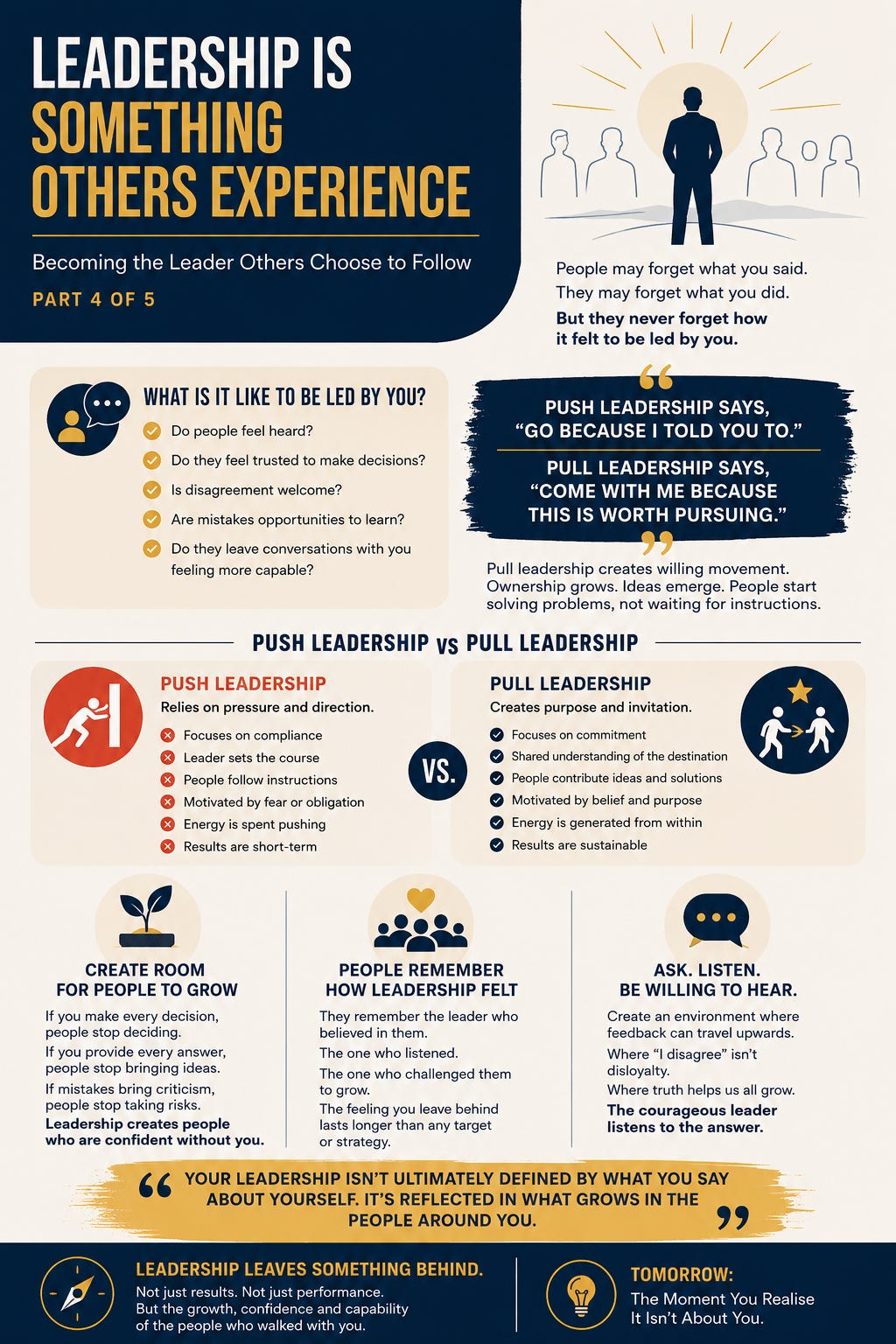
What Is It Like to Be Led by You?
That’s a question I think is worth sitting with.
Not: What kind of leader do I think I am?
Not: What does my leadership profile say about me?
Not even: What leadership style do I use?
But what is it actually like to be led by me?
Do people feel heard when they speak to me? Do they feel trusted to make decisions, or do they feel they need my permission for everything? Do they know that disagreement is welcome, or have they learned that agreeing with the leader is safer?
Do they feel that mistakes are opportunities to learn, or something to hide?
Do they leave conversations with me feeling more capable, or less?
Those questions tell us something a leadership title never can.
We tend to judge our leadership by our intentions. Other people experience it through our actions.
And there can sometimes be quite a gap between the two.
Intentions Aren’t Enough
Most leaders don’t wake up in the morning intending to make someone’s working day miserable.
We don’t normally set out to micromanage, discourage, intimidate or make people feel insignificant. In fact, most of us probably believe we’re doing exactly the opposite.
We think we’re being helpful when we step in.
We think we’re maintaining standards when we correct something.
We think we’re being decisive when we make the decision ourselves.
We think we’re protecting someone when we don’t give them the difficult assignment.
And sometimes we are.
But sometimes our helpfulness feels like a lack of trust. Our high standards feel like nothing is ever good enough. Our decisiveness leaves no room for other people’s ideas, and our protection prevents someone from discovering what they’re capable of.
That’s why I think leadership requires more than good intentions. It requires enough self-awareness to ask how those intentions are actually being experienced by others.

Creating Room for People to Grow
Previously, I’ve written about my belief that one of the greatest responsibilities of leadership is helping other people grow.
But growth needs room.
If I make every decision, I shouldn’t be surprised when people stop making decisions. If I provide every answer, eventually people may stop bringing me ideas. If every mistake is met with criticism, people become very good at hiding mistakes. And if I need to be the smartest person in every room, I’m probably limiting the potential of everyone else in it.
Leadership isn’t about making yourself indispensable. In many ways, I think good leadership should do the opposite. It should create people who are increasingly confident without you. People who can make decisions you once made. People who challenge your thinking. People who bring ideas you hadn’t considered. People who eventually become better at things than you are.
I’ve been fortunate throughout my career to work with people who became far better than me in their particular areas of expertise. I never saw that as threatening. Surely that’s exactly what we should want.
If everyone around us can only ever rise as high as we have, we’ve created a ceiling rather than an opportunity.
Push or Pull?
There’s another way I’ve come to think about this: the difference between push leadership and pull leadership.

Push leadership relies heavily on direction. The leader sets the course, gives the instruction, applies pressure and pushes people towards the desired outcome. And I should acknowledge that this can work. Some people respond well to very directive leadership, and there are certainly situations where a leader simply needs to make a decision and say, “This is what we’re doing.”
But personally, I’ve never responded particularly well to being pushed. And perhaps unsurprisingly, it isn’t how I naturally want to lead others either.
I much prefer the idea of pull leadership.
Rather than pushing people towards an outcome, I want to create something they want to move towards. Give people a reason to care about where we’re going. Help them understand why their contribution matters. Give them enough ownership that it becomes partly their destination rather than simply mine.
For me, that’s where vision becomes important. Vision isn’t just the leader standing at the front pointing towards the horizon. It’s helping other people see something compelling enough that they want to start walking towards it too.
And once people begin moving because they believe in the destination rather than because someone is pushing them from behind, something changes. Ownership grows. Ideas emerge. People begin solving problems rather than waiting for instructions.
That doesn’t mean a pull leader never challenges people. I’ve challenged people throughout my career, and I’ve sometimes pushed people beyond what they believed they were capable of. But there’s an important distinction between challenging someone to grow and pushing someone to comply.
Push leadership says, “Go because I told you to.” Pull leadership says, “Come with me because this is worth pursuing.”
I know which one works better on me.
And I know which kind of leader I’d rather be.
People Remember How Leadership Felt
Think about the leaders you’ve worked with over the years.
You probably don’t remember every decision they made. You almost certainly don’t remember every meeting they chaired, every target they set or every presentation they gave. But you probably remember how it felt to work with them. You remember the leader who believed in you. The one who gave you an opportunity before you were completely ready. The one who listened to an idea that wasn’t fully formed yet. The one who defended the team when things went wrong and shared the credit when things went right.
Unfortunately, we remember the opposite too.
The leader whose mood determined the atmosphere of the room. The one everyone was afraid to disagree with. The one who took the credit but distributed the blame. The one who made talented people question whether they were actually any good.
Those experiences stay with us, sometimes for years. And whether we realise it or not, we’re creating those experiences for other people right now.
Your leadership isn’t ultimately defined by what you say about yourself. It’s reflected in what grows in the people around you.
Leadership Leaves Something Behind
Perhaps this is why I increasingly think leadership is less about what we accomplish personally and more about what happens to other people while we’re accomplishing it.
Results matter. Targets matter. Strategy matters. Businesses need to perform, and leaders have a responsibility to deliver.
But how we get there matters too.
If we achieve extraordinary results while exhausting, diminishing or driving away everyone around us, I’m not sure we can call that extraordinary leadership.
Equally, caring about people doesn’t mean avoiding difficult conversations, lowering expectations or accepting poor performance. Some of the most important things a leader can do are challenge someone, tell them something they don’t particularly want to hear, or push them beyond what they currently believe they’re capable of.
The difference is the reason we’re doing it.
Are we trying to demonstrate our authority?
Or are we genuinely trying to help them become better?
People can usually tell.
Perhaps We Should Ask Them
There’s an obvious problem with asking ourselves what it’s like to be led by us.
We’re probably the least objective person available to answer the question. So perhaps part of becoming a better leader is creating relationships in which people can actually tell us.
That requires trust going both ways. It means creating an environment where someone can disagree with us without wondering what it will cost them, where feedback can travel upwards as well as downwards, and where “I think you got this wrong” isn’t treated as an act of disloyalty.
That’s not always comfortable.
But leadership probably shouldn’t always be comfortable.
If we only surround ourselves with people who confirm the leader we already believe ourselves to be, we may never discover the leader everyone else is actually experiencing.
So perhaps today there is a different leadership question worth asking.
What is it like to be led by me?
And perhaps the really courageous part isn’t asking the question. It’s being willing to listen to the answer.
Tomorrow, we’ll finish this series by looking at what I think may be one of the biggest shifts in our understanding of leadership:
The moment we realise it isn’t about us.
This is part 4 of a 5-part series called “Becoming the Leader Others Choose to Follow”. I will add the other parts below as I post them.
Part 1:

Part 2:
Why Would Anyone Choose to Follow You?

Yesterday (“Leadership Begins Before the Title” - above), I finished with a question.
Part 3:
The First Person You Have to Lead Is Yourself

Yesterday (“Why Would Anyone Choose To Follow You?” - above), I asked a difficult question:
Part 4: This article.
Part 5: Coming Friday