

Yesterday (“Why Would Anyone Choose To Follow You?” - above), I asked a difficult question:
If nobody had to follow you, would anyone still choose to?
Today, I’d like to ask another.
Would you choose to follow yourself?
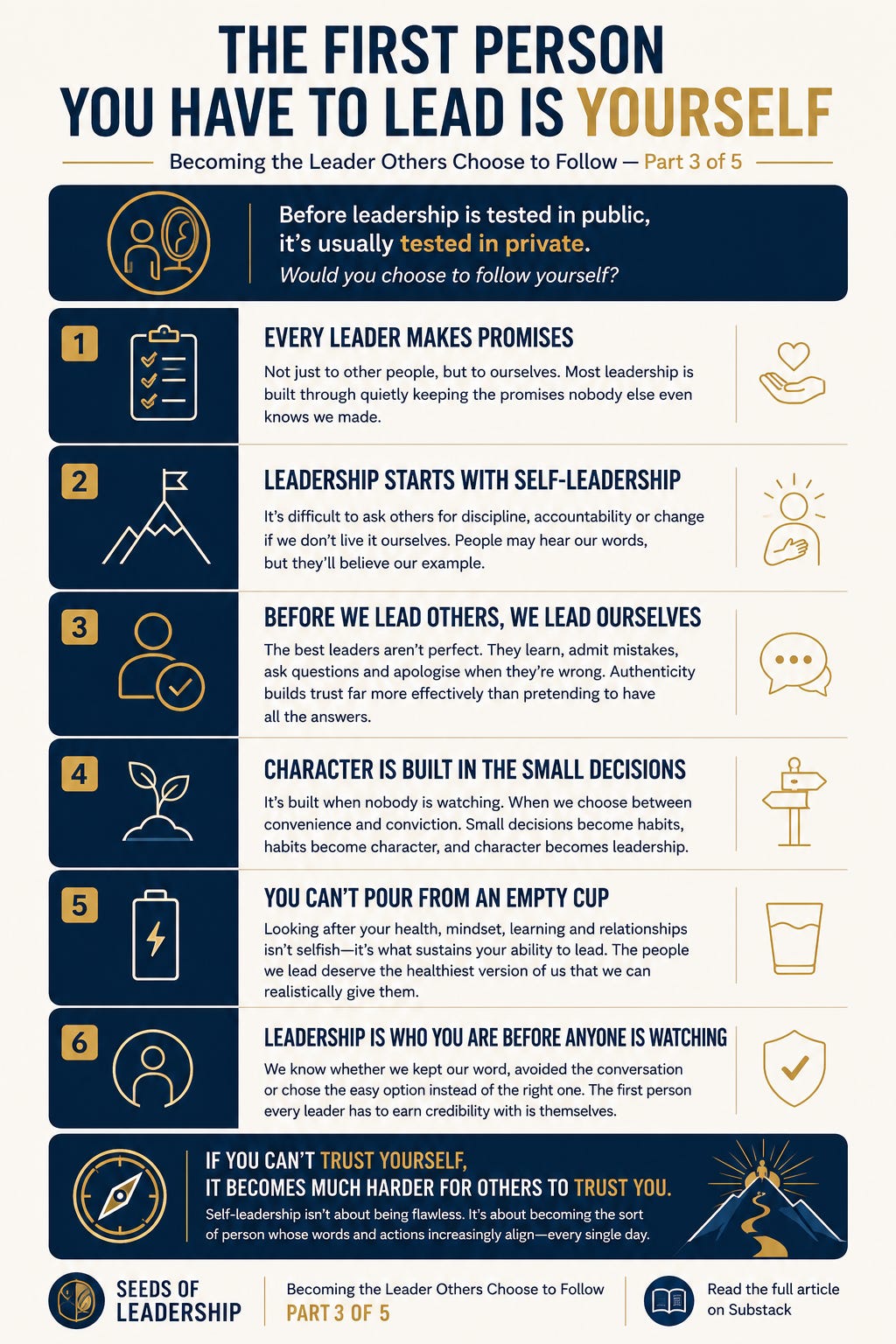
Not the version of yourself you hope to become someday, but the person you are today. Because before leadership is tested in public, it’s usually tested in private.
Every Leader Makes Promises
Every one of us makes promises—not just to other people, but to ourselves. We tell ourselves we’ll get up earlier, make time to learn, have the difficult conversation, stop avoiding that decision, be more patient, spend more time with our family, look after our health, or finally finish what we started.
Most leadership isn’t built through dramatic moments. It’s built through quietly keeping the promises that nobody else even knows we made.
Leadership Starts With Self-Leadership
It’s difficult to ask other people to be disciplined if we aren’t. It’s difficult to expect accountability if we avoid it ourselves, or to ask people to embrace change if we’re unwilling to change.
People may hear our words, but they’ll believe our example. That’s why self-leadership matters so much—not because we need to become perfect, but because leadership gains credibility when our actions consistently support our message.

Before We Lead Others, We Lead Ourselves
I don’t think people expect leaders to know everything. I certainly don’t. The best leaders I’ve worked with weren’t perfect; they changed their minds when they learned something new, admitted mistakes, asked questions and apologised when they got something wrong.
Ironically, those moments didn’t weaken their leadership—they strengthened it. Authenticity builds trust far more effectively than pretending to have all the answers.
Character Is Built in the Small Decisions
We often imagine that character is revealed during life’s biggest moments. Perhaps it is, but I suspect it’s mostly built long before those moments arrive.
It’s built when nobody is watching, when it’s easier to cut corners, and when nobody would notice if we did. It’s built when we choose between convenience and conviction, because those small decisions quietly become habits, those habits become character, and eventually our character becomes our leadership.
You Can’t Pour From an Empty Cup
Many leaders spend so much time looking after everyone else that they gradually stop looking after themselves. They become exhausted, reactive and impatient—not because they stopped caring, but because they stopped recovering.

Self-leadership isn’t selfish. Looking after your physical health, protecting your mental wellbeing, making time to think, continuing to learn and investing in your relationships aren’t distractions from leadership—they’re what sustain it.
The people we lead deserve the healthiest version of us that we can realistically give them. That doesn’t mean we’re always at our best, but it does mean recognising that our ability to lead others is directly influenced by how well we lead ourselves.
Leadership Is Who You Are Before Anyone Is Watching
Long before other people experience our leadership, we do. We know whether we kept our word, avoided the conversation, blamed someone else or chose the easy option instead of the right one.
That’s why the first person every leader has to earn credibility with is themselves. We can’t hide behind a title or reputation when we’re alone with our own decisions.
If You Can’t Trust Yourself…
…it becomes much harder for others to trust you. Self-leadership isn’t about being flawless; it’s about becoming the sort of person whose words and actions increasingly align.
It’s about continuing to learn, continuing to grow, continuing to show up and continuing to try again after failure. Every time we keep a promise to ourselves, we quietly strengthen something that every leader needs: integrity.
Perhaps that’s where genuine leadership really begins. Not in the boardroom, not on the stage and not when everyone is watching, but in the ordinary decisions that nobody else ever sees.
Tomorrow we’ll turn the question around completely. Instead of asking what leaders do, we’ll ask what leadership actually feels like for the people experiencing it.
This is part 3 of a 5-part series called “Becoming the Leader Others Choose to Follow”. I will add the other parts below as I post them.
Part 1:

Part 2:
Why Would Anyone Choose to Follow You?

Yesterday (“Leadership Begins Before the Title” - above), I finished with a question.
Part 3: The First Person You Have to Lead Is Yourself
This article.
Part 4: Coming Thursday
Part 5: Coming Friday