

At some point in our leadership journey something changes.
Perhaps early on, leadership naturally feels quite personal. We want to prove ourselves. We want to make good decisions, deliver results and demonstrate that the person who trusted us with responsibility made the right choice.
There’s nothing necessarily wrong with that. We have to learn. We make mistakes. We develop confidence and discover what kind of leader we want to become.
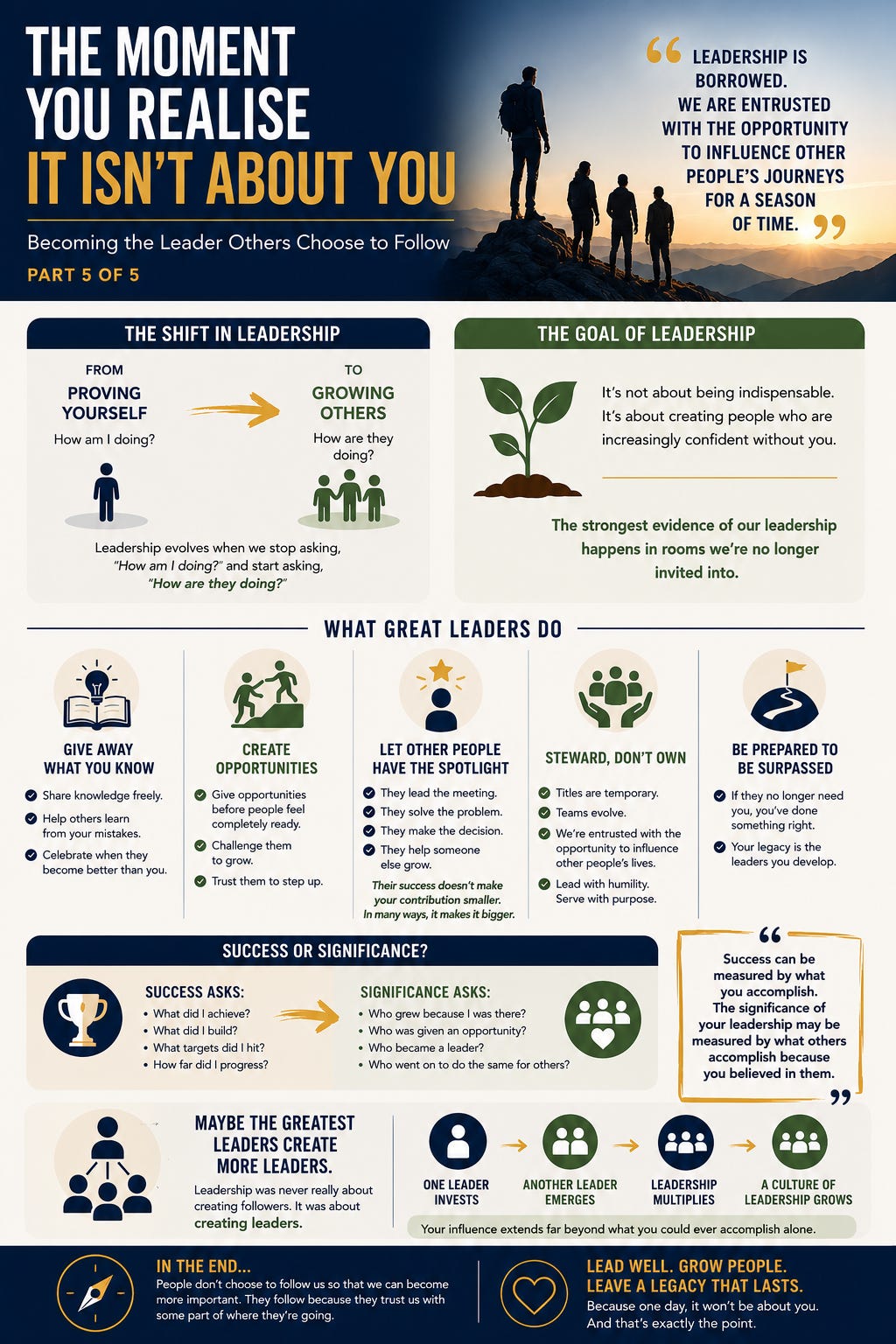
But somewhere along the way, if we’re fortunate, our perspective begins to shift. We stop asking quite so often, “How am I doing?” And start asking: How are they doing?
That’s the moment leadership starts becoming less about us.
From Proving Yourself to Growing Others
When we’re given responsibility for the first time, it can feel as though we’re supposed to have the answers. After all, we’re the leader; we’re the one people are looking to.
We solve problems, we make decisions, we step in when things aren’t working, we try to demonstrate competence because we assume that’s what leadership requires. For me though, that experience gradually taught me something different:
If I’m always the person with the answer, I’m probably not developing enough people who can find the answer without me.
If every important decision eventually arrives on my desk, I haven’t created leadership. I’ve created dependency.
And if the team only performs well while I’m standing in the middle of it, I’m not sure I’ve built anything particularly strong.
The goal changes.
Instead of demonstrating how capable we are, we begin creating opportunities for other people to discover how capable they are.
Perhaps the greatest achievement of leadership isn’t becoming indispensable. It’s helping other people discover that you aren’t.
That can be surprisingly difficult for leaders.
Being needed feels good. Being the person with the answer feels good. Being included in every decision can even feel like evidence that we’re doing an excellent job. But sometimes the strongest evidence of our leadership is happening in rooms we’re no longer invited into...because people don’t need us there anymore.

Give Away What You Know
I’ve never understood leaders who protect knowledge as though sharing it somehow diminishes their value. If I know something that can help someone else become better at what they do, why wouldn’t I share it? If someone can learn from my mistakes without having to make every one of them themselves, even better and if someone eventually becomes better than me at something I helped them learn, that’s not a threat to my leadership.
That’s evidence of it.
Leadership shouldn’t create a queue of people waiting for the leader to solve their problems. It should create people who are increasingly confident in solving problems themselves—and eventually helping others do the same.
That’s when leadership begins to multiply. One person develops another...who develops another...who sees potential in someone else. Therefore, all of a sudden, the influence of one leader extends far beyond anything they could have achieved personally.
Let Other People Have the Spotlight
There’s another shift that comes with this: you become increasingly comfortable not being the person receiving the credit.
I’ve always believed that when something goes well, the people who did the work should be recognised for it. When something goes wrong, leadership has a responsibility to step forward rather than backwards. That doesn’t mean leaders should become invisible or pretend they haven’t contributed. But there’s a difference between participating in success and needing to own it.
Some of the best moments in leadership come when you watch someone you’ve encouraged succeed without needing anything from you.

They lead the meeting. They solve the problem. They win the client. They make the decision. They challenge an assumption. They help someone else grow. And perhaps you sit quietly at the edge of it and think:
Look at what they’ve become.
There’s something deeply satisfying about that because their success doesn’t make your contribution smaller. In many ways, it makes it bigger.
Leadership Is Borrowed
Titles are temporary. Organisational charts change. Businesses are acquired. Teams evolve. People move on. Eventually every one of us leaves the position we currently occupy.
I’ve experienced enough change in my own career to know how quickly the title beside your name can change while the relationships you’ve built remain. That’s why I increasingly think leadership is something we’re entrusted with rather than something we own. For a period of time, we’re given the opportunity to influence other people’s working lives.
Think about what that means.
For several hours every day, perhaps for years, our behaviour can affect someone’s confidence, development, opportunities and even how they feel when they go home at the end of the day. That’s an enormous responsibility and it shouldn’t be taken lightly. We don’t own the people we lead, nor their successes, and certainly not their ideas. We simply have an opportunity, for however long our paths overlap, to help them become more capable of travelling theirs.
Success or Significance?
I’ve written before about why I favour significance over success, and leadership may be one of the clearest examples of the distinction.

Success asks:
What did I achieve?
What did I build?
What targets did I hit?
How far did I progress?
Those questions matter. Results matter. Businesses cannot survive on good intentions, and leadership that consistently fails to deliver eventually fails the people depending upon it too.
But significance asks different questions.
Who grew because I was there?
Who became more confident?
Who was given an opportunity?
Who discovered something in themselves they hadn’t seen before?
Who became a leader?
And perhaps most importantly:
Who went on to do for someone else what someone once did for them?
That’s a very different kind of legacy.
Success can be measured by what you accomplish. The significance of your leadership may be measured by what others accomplish because you believed in them.
Becoming the Leader Others Choose to Follow
This week began with a simple idea: leadership begins before the title.
From there, we asked why anyone would choose to follow us at all. We considered the importance of leading ourselves before expecting to lead anyone else, and yesterday we turned the question around and asked what our leadership actually feels like to the people experiencing it.
Perhaps all four questions bring us here.
People don’t choose to follow us so that we can become more important. They choose to follow because they trust us with some part of where they’re going.
Our responsibility is to be worthy of that trust.
To create direction without needing to control every step.
To challenge people without diminishing them.
To share what we know.
To listen when we’re wrong.
To give opportunities before people feel completely ready.
To create room for people to become better than us.
And eventually, to be completely comfortable when they no longer need us.
Because perhaps leadership was never really about creating followers.
Maybe the greatest leaders create more leaders.
And when we understand that, something changes.
We stop measuring leadership by how many people are looking towards us.
We start noticing how many people around us are becoming capable of leading others.
That might be the moment we finally understand what leadership was for.
It was never really about us.
This is the last part of a 5-part series called “Becoming the Leader Others Choose to Follow”. The other parts can be found here:
Part 1

Part 2
Why Would Anyone Choose to Follow You?

Yesterday (“Leadership Begins Before the Title” - above), I finished with a question.
Part 3
The First Person You Have to Lead Is Yourself

Yesterday (“Why Would Anyone Choose To Follow You?” - above), I asked a difficult question:
Part 4
Leadership Is Something Others Experience

Thanks for reading Seeds of Leadership! This post is public so feel free to share it.
Part 5
This article.