

It’s remarkable how quickly our expectations can turn celebration into disappointment.
That was certainly my experience watching AS Béziers Hérault play Grenoble on Friday evening.

Going into the match, I wasn’t particularly optimistic. Béziers were sitting second from bottom in the league, having suffered a painful 54–3 defeat away at Provence Rugby just one week earlier, while Grenoble arrived in third place, having won their previous five matches. On paper, it hardly looked like an evenly matched contest.
I’d even warned my son, Declan, that we might be in for another difficult evening, suggesting he should prepare himself for the possibility of losing by 50 points.
It wasn’t that I didn’t want Béziers to win. Of course I did. But there is a difference between what we hope will happen and what we realistically expect, and the evidence available before kick-off wasn’t particularly encouraging.
Yet from the beginning, Béziers looked like a team determined to challenge those expectations.

Their defence was strong, they maintained good possession, and they played with a discipline that had sometimes been missing in previous performances. Against a Grenoble side that had won five consecutive matches, Béziers weren’t simply trying to avoid another heavy defeat; they were competing on equal terms. As the evening progressed, what had initially seemed an unlikely possibility began to feel increasingly realistic.
Then, with just two minutes remaining, Béziers were awarded a penalty near the halfway line. It was a difficult kick, but it went over, and suddenly we were ahead. After arriving at the stadium prepared for a potentially heavy defeat, we were now contemplating a remarkable victory.
But with approximately a minute remaining, Grenoble retook the lead.
Béziers had come agonisingly close, eventually losing by just two points. They earned a valuable defensive bonus point, but the victory that had briefly seemed within reach had slipped away.
I was disappointed, naturally, but also enormously encouraged by what I’d seen. Declan felt rather differently. Having watched his team take the lead so close to the final whistle, he’d begun to believe they were going to win. His disappointment was evident, and he barely spoke on the journey home.
The result hadn’t changed what Béziers had achieved that evening. What had changed was what we’d come to expect of them.
When Expectations Change
Before the match, I suspect both of us would have been delighted to know that Béziers would finish within two points of Grenoble. After everything that had happened the previous week, that would have represented a considerable improvement.
Yet when the final whistle arrived, the disappointment was real. Somewhere during those eighty minutes, our expectations had shifted, and with them, our perception of what constituted a successful evening. At the beginning of the match, we were evaluating Béziers against the possibility of another heavy defeat. By the closing minutes, we were contemplating victory. Grenoble’s late score couldn’t erase the quality of Béziers’ performance, although it certainly changed how we felt about the result.
I think this happens frequently in business, although we don’t always recognise it. A team might begin with relatively modest expectations, perhaps because the business has been struggling, a product has been underperforming or a department has experienced difficulties. The initial objective might simply be to stabilise the situation, restore confidence or return to an acceptable level of performance. Then things begin to improve. Customers respond positively, the team starts working more effectively, and objectives that once seemed ambitious become increasingly achievable. As confidence grows, so do expectations.
There is nothing inherently wrong with this. In fact, increasing expectations can be a natural and healthy consequence of improvement. We should want teams to develop their capabilities, become more ambitious and recognise what they might achieve. The difficulty arises when we forget how much those expectations have changed, particularly when achievements that would once have been celebrated begin to be treated as merely satisfactory.
When Exceptional Becomes Expected
One of the interesting consequences of success is that it rarely remains exceptional for very long. A business wins its largest-ever customer, launches a successful product or delivers a particularly strong financial year. Initially, the achievement is celebrated. It demonstrates what the organisation is capable of accomplishing and creates confidence about what might come next. Over time, however, that achievement establishes a new reference point against which future performance is measured.
The following year, stakeholders may expect another major customer, another successful launch or further growth. What was previously considered exceptional gradually becomes an expectation, and repeating the achievement may receive considerably less recognition than the original success. While it’s reasonable for expectations to evolve, we should be careful about assuming that an achievement can necessarily be repeated with the same resources, under the same conditions or within the same timeframe. A major customer contract, for example, might represent the culmination of several years of relationship-building, negotiations and effort. The resulting sale may appear in a single year’s financial results, while the work required to secure it, and the uncertainty surrounding when it would materialise, can be far less visible.
I’ve experienced this tension in business leadership. Before the business I led was acquired, we often measured our commercial performance against the dollar value of sales achieved in previous years. When we had a particularly successful year, that figure naturally became a benchmark for the following year. We wanted to match it, preferably exceed it, and demonstrate that the business was continuing to grow. However, falling short of that particular figure wasn’t necessarily a disaster. We understood that individual years could be influenced by unusually large contracts or other circumstances, and our broader objective was to continue growing the business. Sometimes looking at the average performance over the previous three or five years provided a more meaningful indication of our progress than comparing two individual years.
When Expectations Outpace Capacity
Percentage growth targets introduce a different dynamic. When a business achieves its growth target, that success becomes the starting point for the following year’s expectations. The organisation is then expected to deliver further growth on an already increased base. There’s nothing inherently unreasonable about this; sustained growth is an important objective for many businesses. However, when an organisation is already operating with limited resources, each successive increase can place additional demands on people and capabilities that may already be stretched.
After acquisition, I remember one year when we achieved our annual growth target in December. By that point, I was already working on the financial plans for the following year and beyond. We didn’t have time to pause and celebrate our achievement because our attention was already turning towards the following year’s objectives. Had we reached the target earlier, we might have celebrated briefly, but I suspect the focus would quickly have shifted to how much more we could achieve before the year ended.
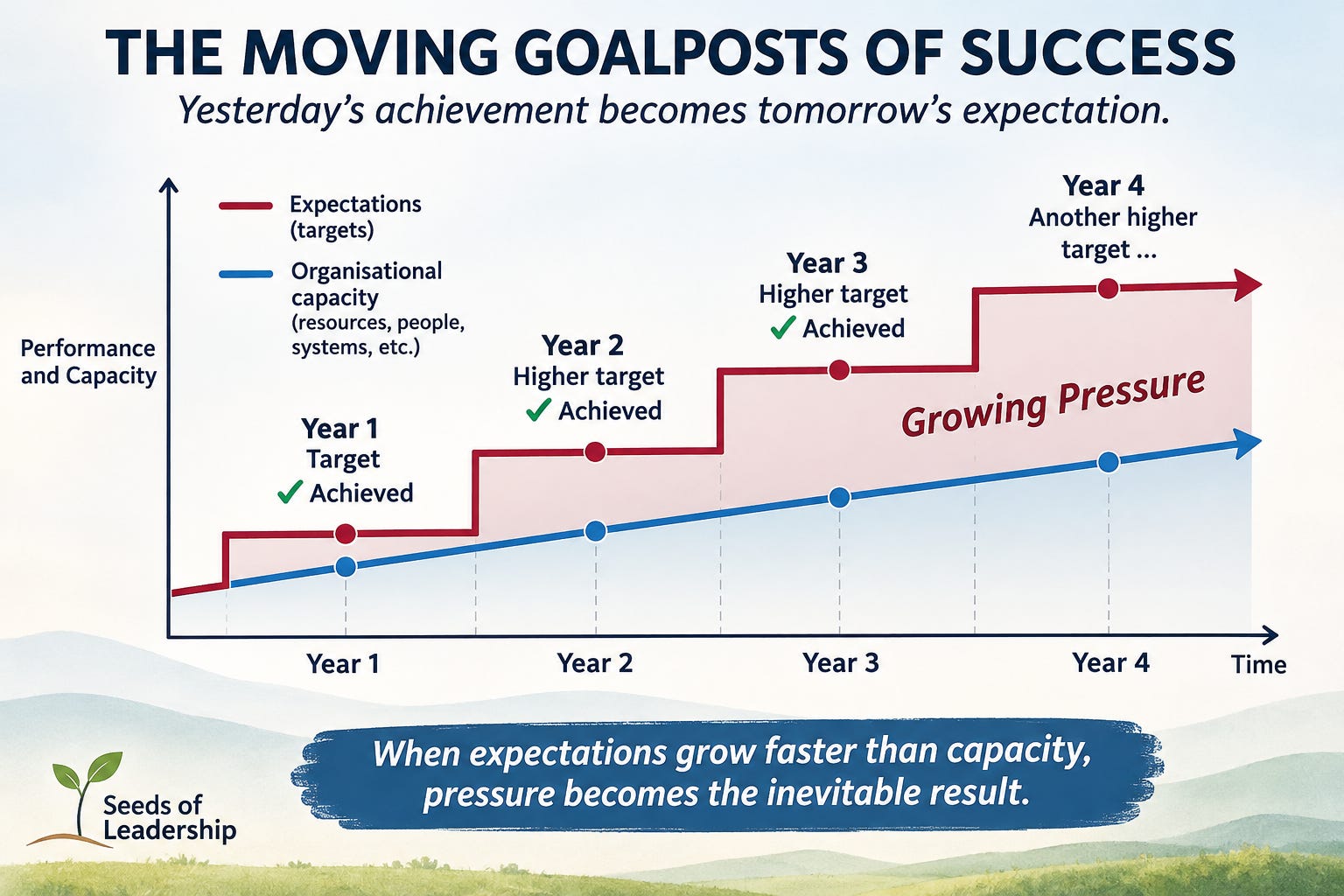
There’s a tendency to look towards the next achievement, sometimes before we’ve paused to recognise the significance of the one we’ve just accomplished. An organisation needs to keep moving forward, but its people also need opportunities to pause and recognise when they’ve achieved something worthwhile.
Over time, this can become increasingly difficult to sustain. The organisation may be achieving its objectives, developing its capabilities and delivering genuine improvements, yet the expectations continue to rise. Without corresponding investment in people, systems or other resources, the pressure can accumulate, leaving teams wondering when their efforts will translate into a more manageable workload. The next target is always waiting, and the prospect of some breathing room can begin to feel increasingly distant.
The Difference Between Ambition and Moving the Goalposts
Let’s consider ambition, which can be enormously motivating. When people achieve something they previously thought impossible, their confidence grows, and so does their willingness to take on new challenges. Good leaders recognise this potential and encourage people to develop it further. But imagine a team that has worked exceptionally hard to reach an ambitious target, perhaps even exceeding what was originally expected, only to discover that their achievement has immediately become the minimum acceptable standard for the next period. What should have been an opportunity to recognise their progress becomes another reminder of how much more is expected of them.
I think this is where leaders can make a significant difference. There’s a considerable difference between recognising an achievement and inviting people to consider what might now be possible, and immediately responding to success by demanding more. The objectives may ultimately be similar, but the message received by the team can be very different. In the first instance, the achievement provides a foundation for further ambition. In the second, the achievement itself risks losing its significance because attention has already shifted to the next objective.
Of course, leaders have responsibilities that extend beyond celebrating success. Businesses need to grow, improve their performance and respond to changing circumstances. Sometimes that means establishing demanding targets, even when resources are constrained or the team would prefer a period of consolidation. But those expectations should be accompanied by an honest assessment of what’s required to achieve them, including the investment, capabilities and time available.
Perhaps the most important consideration is that recognition and ambition don’t have to compete with one another.
We can acknowledge the significance of an achievement while encouraging people to pursue something greater. Indeed, recognising how far a team has progressed may provide precisely the confidence it needs to take on the next challenge.

Recognising What the Scoreboard Doesn’t Show
Returning to that Friday evening in Béziers, I think there’s an important lesson in how we evaluate progress. The scoreboard showed that Grenoble had won by two points, and ultimately, that was the result that mattered in the league standings. Béziers had lost another match, although they had earned a valuable defensive bonus point.
But the scoreboard doesn’t tell the whole story.
Having watched Béziers over several home matches, I’d seen signs of improvement. Against Grenoble, those improvements were particularly evident. Their defence was stronger, they maintained possession more effectively, and there was a level of discipline and determination that suggested the team was making genuine progress. Just a week after losing 54–3, they had competed with one of the league’s stronger sides and come within moments of winning.

Of course, none of that changes the result. Béziers still need victories, and I’m sure the players and coaching staff would have preferred a victory to the satisfaction of a strong performance. But if we judge their progress exclusively by whether they won or lost, we risk overlooking the improvements that may eventually make those victories possible.
I think the same principle applies to leadership. Results matter, and organisations cannot sustain themselves indefinitely on the promise of future success. However, the measures we use to evaluate performance should also help us understand whether we’re moving in the right direction. A team might fall short of its financial target while improving customer relationships, strengthening its capabilities or developing opportunities that will contribute to future growth. Those improvements deserve recognition, even when the immediate results remain disappointing.
This doesn’t mean lowering our expectations or becoming satisfied with falling short. It means recognising that progress and results don’t always arrive at the same time. Leaders need to understand both, particularly when deciding whether a team needs a different approach, additional support or simply more time for its efforts to produce the desired outcome.

As I reflected on the match afterwards, I realised that my expectations had changed considerably during those eighty minutes. I’d arrived hoping Béziers could avoid another heavy defeat and left disappointed that they hadn’t won. Yet I was also encouraged by what I’d witnessed, and I didn’t want the disappointment of those final moments to overshadow the progress the team had demonstrated.
Perhaps that’s something worth remembering whenever we find ourselves raising expectations: the fact that we now believe more is possible shouldn’t prevent us from recognising how much has already been achieved.
Related reading: More Than the Final Score

Keeping the Goalposts in Sight
As our capabilities develop, so do our expectations of what we can achieve. That’s a natural part of progress, whether we’re talking about sport, business or our own personal development. Achievements that once seemed beyond our reach can give us the confidence to pursue something greater.
But I think we need to be conscious of how we respond when our expectations change, particularly when we’re responsible for leading others. Achievements deserve recognition for what they represent, even when they encourage us to believe that something greater might now be possible. And while the next objective will always demand our attention, we shouldn’t allow it to diminish the significance of what has already been accomplished.
Perhaps the challenge for leaders is to keep raising their ambitions without continually redefining what counts as success.
And that leaves me with a question:
When your team’s performance improves and your expectations rise, how do you make sure you’re still recognising just how far they’ve come?