

I ended the previous article in this series with a question about what happens to an organisation when its founder is gone. It was a question prompted by Bruce McLaren and the team he built. When Bruce died in 1970, he left behind an organisation with a reputation for ingenuity and collaboration, and a determination to challenge established competitors. McLaren carried on and won world championships during the 1970s, but by the end of the decade it was struggling to keep pace. The team now had to find a new direction while building on the qualities that had made it competitive in the first place.
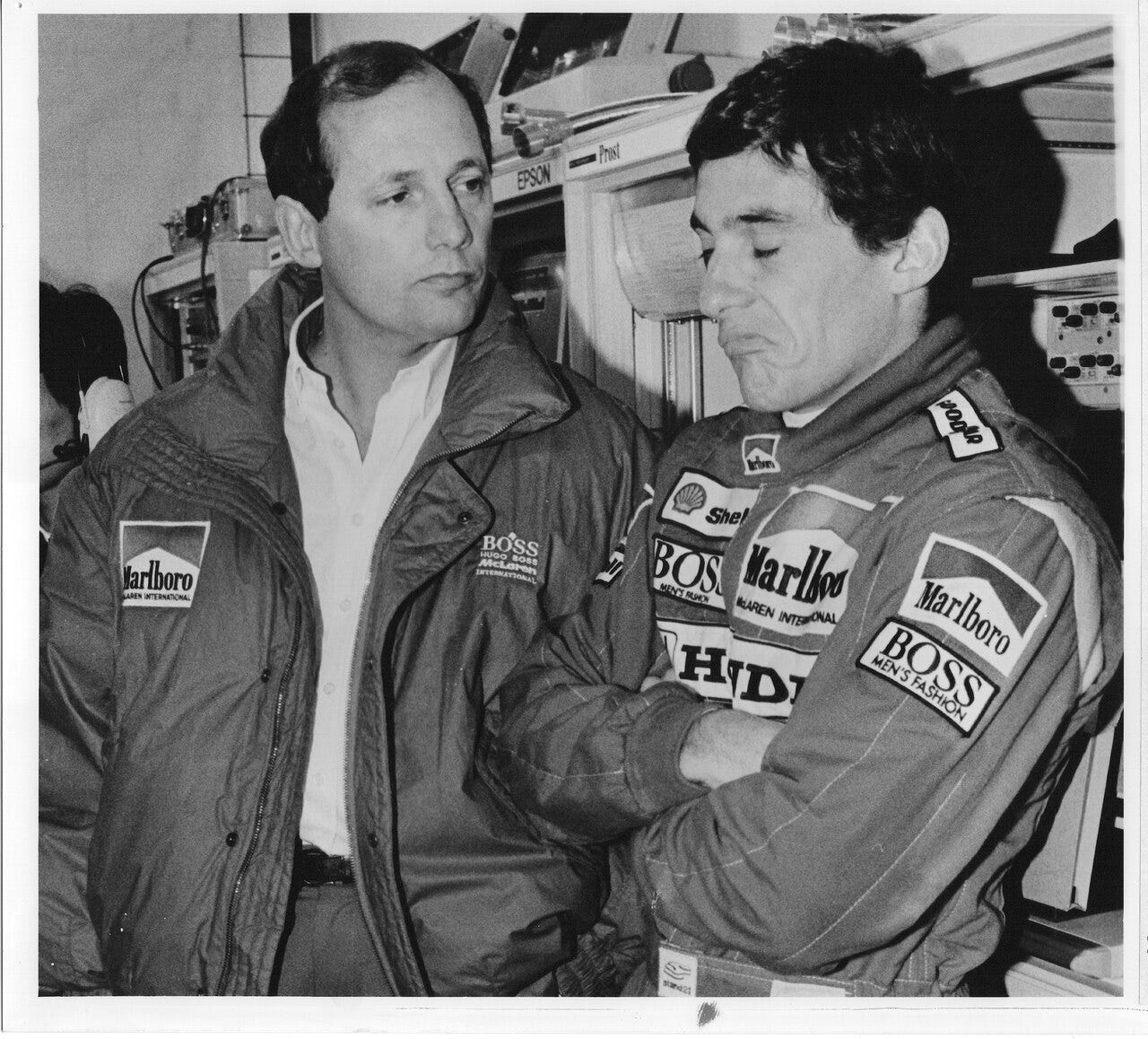
The turning point came in 1980, when Ron Dennis’s Project Four operation joined forces with McLaren. Dennis brought the experience of running his own team and a view of what McLaren could become. The arrangement, encouraged by their shared sponsor Marlboro, brought together McLaren’s established Formula One presence and Project Four’s technical ambitions. 1
Over the following decades, Dennis became associated with meticulous attention to detail, demanding standards and an almost uncompromising pursuit of perfection. His leadership helped transform McLaren into one of Formula One’s most successful organisations. His story raises a question relevant to any business that has grown around a strong leader. Can the very qualities that create exceptional performance eventually limit an organisation’s ability to change?
“a precise and structured culture and very clear goals”
David Coulthard
From Mechanic to Entrepreneur
In 1966, the year McLaren made its Formula One debut, Ron Dennis was starting his own career in the sport as a mechanic at Cooper. He followed Jochen Rindt to Brabham in 1968 and went on to start Rondel Racing with fellow Brabham mechanic Neil Trundle. Rondel competed in Formula Two, and when it folded, a contract to run a Formula Two programme for Marlboro gave Dennis the money to start again. By 1976 he was running Project Four, which went on to win back-to-back British Formula Three titles. 1,2
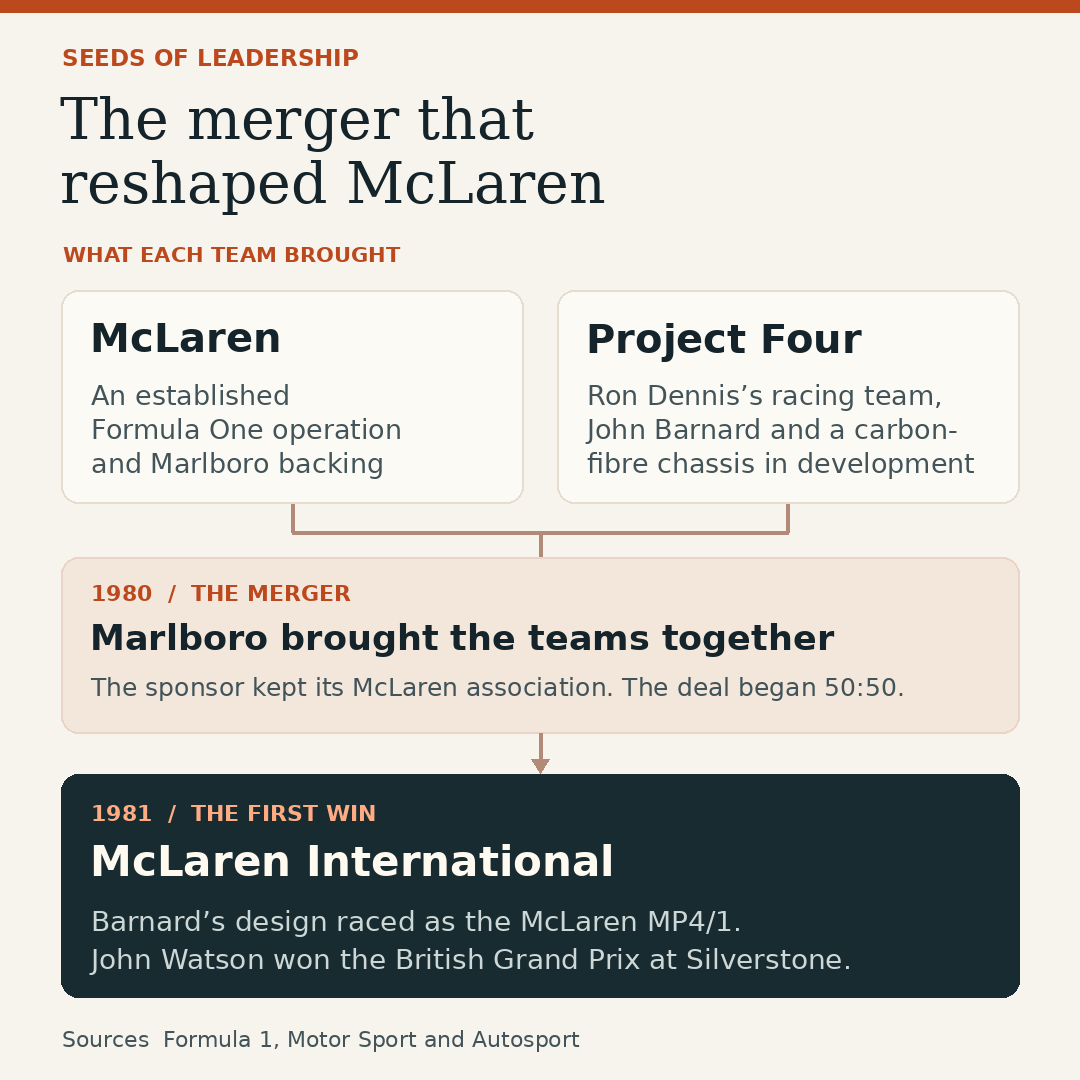
Dennis wanted to take Project Four into Formula One and asked Marlboro to move its sponsorship from McLaren to Project Four. McLaren’s results had slipped, but Marlboro still valued its association with McLaren and helped bring the two operations together in 1980, resulting in the merger of McLaren and Project Four. Dennis later described the deal as a “reverse take-over” that began as a 50:50 partnership, with him and McLaren’s Teddy Mayer as joint managing directors. 1,2
From my own experience with acquisitions, the question I find most interesting is what each side could do with what the other brought to the partnership. McLaren had an established Formula One operation and a major sponsor in Marlboro that wanted to stay. Project Four brought John Barnard and a carbon-fibre chassis already in development, although Dennis still needed the money to finish it. The merger gave Barnard’s design a route to the Formula One grid and gave McLaren a new car around which to rebuild. In 1981, that car raced as the McLaren MP4/1. Dennis recalled that MP4 originally stood for Marlboro Project Four, with the M later coming to stand for McLaren. 1,3
Innovation Requires More Than Ideas
John Barnard had a specific problem to solve. He wanted a narrower chassis to leave more room for the airflow beneath the car, but it still had to be stiff enough to cope with the forces acting on it. Carbon fibre offered a way to achieve both. The material was already used for smaller parts, but building the entire chassis from it was a different proposition. Barnard took a quarter-scale model to Hercules, an American aerospace company, which had the expertise to turn his design into a full-size chassis. 3
Barnard later recalled Dennis’s offer, “you tell me what you want to do technically and I’ll get the money.” It was a clear division of responsibility. Dennis backed an approach whose merits would only become clear once the car was built and raced, while Barnard had the freedom to make the engineering decisions. In July 1981, John Watson won the British Grand Prix at Silverstone in the MP4/1, giving the combined team its first win. 1,3
Years later, David Coulthard wrote that innovation at McLaren was “steeped in the company psyche” (It Is What It Is, 2007, p. 175). He was describing the team from a driver’s perspective more than a decade after the MP4/1. By then, experimenting with new ideas and materials was part of everyday engineering at McLaren. 4
“you tell me what you want to do technically and I’ll get the money.”
Ron Dennis, as recalled by John Barnard
Creating a Culture of Excellence
Ron Dennis once said that winning races was “just doing your job”. He also cared how McLaren won, how the cars and drivers were presented, and what impression the team made on a potential sponsor. There was a commercial logic to that attention to detail. A sponsor was investing in the team it saw throughout a race weekend, and Dennis wanted McLaren’s preparation to be visible in the way it went about its work. 5
By 1988, McLaren had reached a level of performance few teams could match. Ayrton Senna and Alain Prost won 15 of the season’s 16 Grands Prix between them, a result that owed much to Honda and to the people who designed, built and prepared the cars. David Coulthard, who drove for McLaren in a later era, described “a precise and structured culture and very clear goals” (The Winning Formula, 2018, p. 131). His recollection gives a sense of what those standards meant to someone working within the team. 5,6
Former McLaren mechanic Marc Priestley remembered how far that attention to detail could go. When the mechanics used a wet rag to cool the bodywork around the exhausts, Dennis objected to how it looked. By the next race they had tailored black towels embroidered with the drivers’ initials, and the bucket was kept out of sight. Priestley credited Dennis’s methods with helping to build McLaren but recalled good people leaving because they found his expectations difficult to work under. To me, that tension is far more revealing than the story about the towels. As McLaren grew, how did people decide which details needed that level of attention and which they could settle for themselves? 7
Building a Business Beyond Formula One
In September 1988, after the only Grand Prix McLaren lost that season, Ron Dennis, Mansour Ojjeh, Creighton Brown and Gordon Murray found themselves waiting for a delayed flight at Milan’s Linate airport. Murray had been thinking about building a road car for years, and Dennis was looking for ways to broaden McLaren’s business. The conversation brought those ambitions together. Within months, McLaren Cars had been formed and Murray had the opportunity to develop the car he had been imagining. 8,9
Building a business around road cars took a different kind of work.

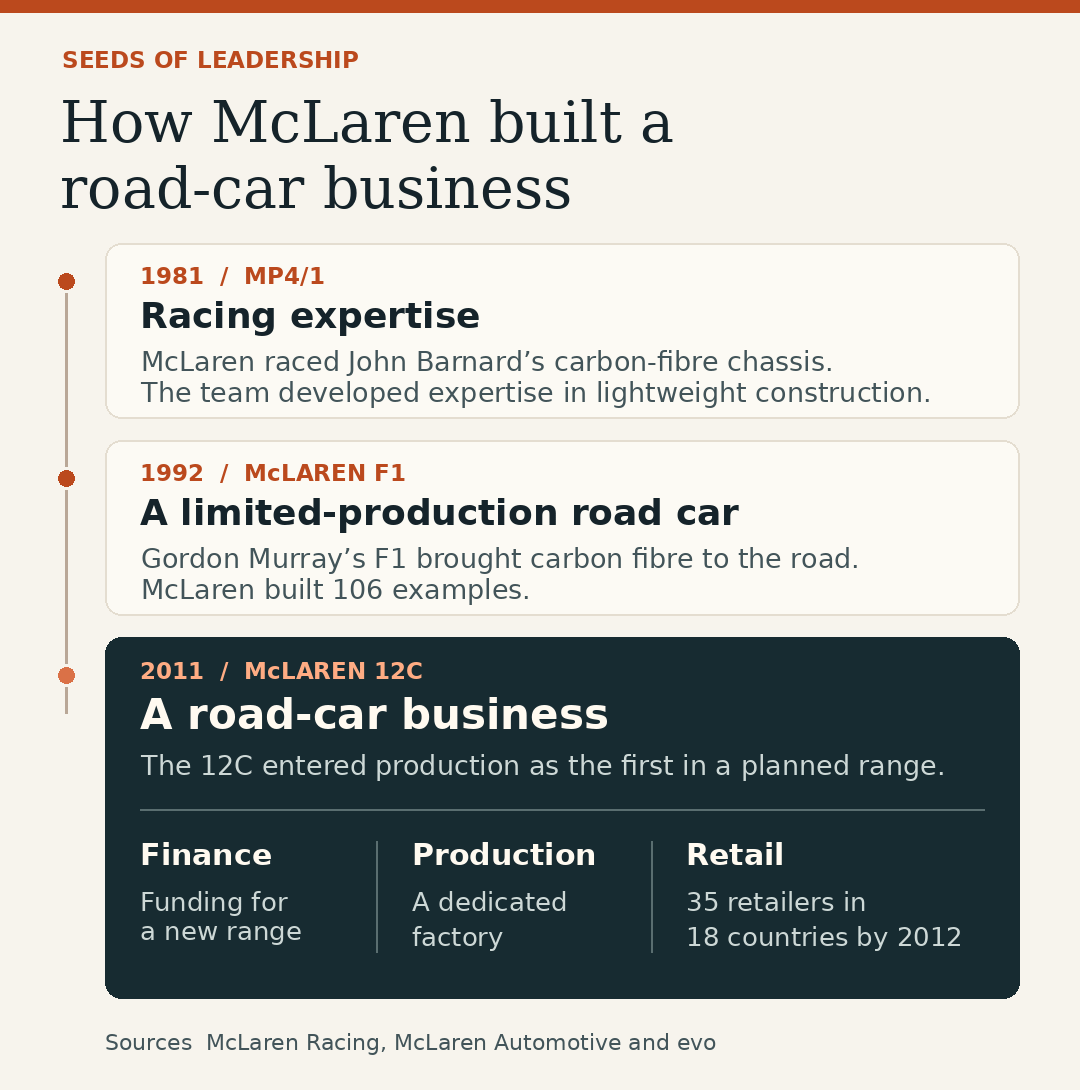
The result was the phenomenal and unique McLaren F1, unveiled in 1992. Its carbon-fibre chassis drew on expertise McLaren had developed in racing, while Murray’s three-seat layout put the driver in the centre. McLaren built just 106 examples. For a company known for building cars to win Grands Prix, the F1 showed what its engineers could do when they started with a road car in mind. 8,9
Building a business around road cars took a different kind of work. When Dennis stepped down as Formula One team principal in 2009, he focused on securing finance for the next generation of cars and planning permission for a new factory. The 12C entered production in 2011 as the first model in a planned range. What interests me about that second step is how much McLaren had to build around the car itself, from a dedicated production facility to a retail network that could reach customers in markets around the world. 10,11
When Strengths Become Constraints
In 2014, Dennis returned as chief executive after McLaren had gone an entire Formula One season without a podium. He said his fellow shareholders had asked him to improve performance on and off the track. His plan was to review each of McLaren’s businesses and look for new ways to put its technology to work. By then, the group included a road-car manufacturer and a technology business alongside the racing team. The job now involved deciding where to invest across several businesses, each with its own demands. 12
Less than three years later, Dennis was out as chief executive. He held 25 per cent of McLaren Technology Group. Mansour Ojjeh, his long-time business partner, held another 25 per cent, and Bahrain’s sovereign wealth fund, Mumtalakat, held the remaining half. When the other shareholders backed his removal in November 2016, Dennis defended his record, saying that his management style was “the same as it has always been”. He saw that continuity as one reason McLaren had grown into an automotive and technology group. In June 2017, he agreed to sell his remaining shares, ending 37 years with McLaren. 13,14
I keep coming back to the role of his business partners. Dennis had built much of McLaren by persuading others to back ideas he could see potential in, from Barnard’s chassis to the road-car business. As the group grew, those partners had their own views about where it should go and the voting power to act on them. The support of his business partners had given Dennis the opportunity to reshape McLaren. In 2016, it became clear how much his ability to keep leading it still depended on that support.

The Legacy of Perfection
When Ron Dennis agreed to sell his shares in 2017, he described his 37 years at Woking as “a chapter in the McLaren book”. It was a long chapter for someone who had arrived with a junior racing team and a car still in development. He saw what Project Four and McLaren could do together, he gave people like John Barnard and Gordon Murray the backing to pursue their ideas, and he helped build a business that could design, manufacture and sell its own road cars. 14
After nearly 18 years at Agronomix, I understand why Dennis put it that way. I think of my own time there as “a chapter in the Agronomix book”. It was a long and important chapter in my working life, and I’m proud of what we built together. Agronomix had a story before I joined, and others are writing the next chapter now.
What stays with me is how much judgement there was in deciding where to get involved. Dennis took a close interest in details that others might have passed over, and some of his biggest decisions involved trusting people with expertise he needed. Both instincts helped him build McLaren. As an organisation grows, how does a leader decide where their own judgement still adds value and where others need the freedom to exercise theirs?
References
1. Motor Sport (2012). Lunch with… Ron Dennis.
2. Formula 1. McLaren at 50: Exclusive Ron Dennis interview.
3. McLaren Racing (2023). MP4/1.
4. Coulthard, D., with Roach, M. (2007). It Is What It Is: The Autobiography. Orion, p. 175.
5. Duff, M. (2010). Ron Dennis: What I’d Do Differently. Car and Driver.
6. Coulthard, D., Gallagher, M. and Roach, M. (2018). The Winning Formula. Blink Publishing, p. 131.
7. Priestley, M. (2016). Working for Ron Dennis: The inside story. Sky Sports.
8. Barlow, J. (2020). The inside story of the McLaren F1. British GQ.
9. McLaren Automotive. McLaren F1.
10. Porter, R. (2009). Ron Dennis interview. evo.
11. McLaren Racing (2012). MIPIM award recognises new McLaren Production Centre.
12. Formula 1 (2014). Dennis succeeds Whitmarsh as McLaren Group CEO.
13. Esler, W. and Gill, P. (2016). Ron Dennis relinquishes role as McLaren chairman and chief executive. Sky Sports.
14. Kleinman, M. and Green, J. (2017). Former chief executive Ron Dennis sells McLaren shareholding. Sky Sports.
This was really interesting. The whole journey. Thanks for sharing. Very inspiring 👌✨